Showing posts with label 80s horror films. Show all posts

Thursday, October 11, 2012

Silver Bullet (1985)

I was flipping through the television channels on Direct TV this morning when I was delighted to see that AMC was showing this entry in the Stephen King film series. Though it’s been a really long time since I’ve sat down in front of it – try about eleven years or so – I was tickled pink to see that it was being broadcast, albeit in a slightly truncated form. I didn’t care, though because my favorite time of year has just kicked off. I just adore October – all the cool channels on cable start busting out classic slasher films and it’s fantastic to see which channels show which films. Everything from the endless Friday the 13th and Halloween movies to the more random cult favorites peppered out amongst the other networks (Sleepaway Camp 2 on Logo tonight, anyone?)

I was first introduced to this film in late 1985 while I was in the seventh grade, but first in the form of Stephen King’s novella, Cycle of the Werewolf. During those years, my family did not even remotely entertain the idea of going to the movie theater for any reason whatsoever, and from the first moment I’d seen the television spot, I had this obsession with wanting to watch it. Primarily because I wanted to be on the same level as the cool kids whose parents had taken them to the local cinema or drive in to give it a gander, but at the same time there was something about the storyline that intrigued me. My grade-school best friend had been subjected to hearing the ranting and the raving about not being able to go to the theater to watch it like everyone else so he went as far as to keep it from me that he’d gone to the theater with his father to watch it the weekend it was released which, of course, devastated me.  But, he went out of his way,  as only a childhood best friend knows how, to hunt down the book and presented it to me the week the film was released so I could keep up with the cool kids and be able to join in on the ‘playground talk’. I mean, I believe every kid who was a horror nut during the 80’s was at one point a Stephen King fanatic. King at that time was the epitome of everything horror, everything definitive when it came to the phantasmagorical.  There wasn’t anyone like him in the world at the time and everything he released in the 80’s still has yet to be matched. Though I have to admit that I was a bit disappointed to see that not only was Cycle of the Werewolf a very short book, it was illustrated as well, something I wasn’t expecting. I took me one night to read it and I can tell you it wasn’t enough. I would stay up late at night and see the TV spots on the local affiliates and silently act out this little fit of anger within me as I had to surrender to the idea that being able to sit in front of this film was completely out of my reach.

I got a nice surprise two years later during one winter as the eighth grade was about to let out for the Christmas Break of 1987, though, as Mrs. Glasgow, the eighth grade American history teacher wasn’t up to putting up with us on the last day of classes. When we got to class on that day’s period, I was pink with barely controlled glee when I saw the school’s TV and VCR sitting at the front of the room with the rental box for Silver Bullet was lying on the tape deck. Boy, did I love the advent of VHS! This was the moment I’d been waiting for. So I pushed through everyone to make my way to the front of the class that was already seated on the floor in front of the television. As excited as I was, and as I sat down, I’d become oblivious to the fact that period only lasted for fifty-five minutes…which meant that I was only able to get just over half-way done with the film before the bell rang to let us out. I was heartbroken. I actually didn’t get to sit in front of this film again until after I graduated from high school and secured my first video rental membership at the local H-E-B Video Central. The first two movies I ever rented on my own at the age of eighteen were Friday the 13th and Silver Bullet. I rented them both that same day; on a weekend my folks were out of town and knowing that I would have the house to myself. I was ready to finally sit in front of this in its entirety.


The film opens up with a narration by Jane Coslaw, the eldest of a family living in Tarker’s Mills, Maine. She is the eldest of two children, the other being her younger brother, Marty (played by 80’s cutie Corey Haim) who happens to be a paraplegic. Their relationship has its ups and down and is very strained but soon begins to change after a bizarre series of murders rock their sleepy town. After several murders, including a railroad worker, and pregnant woman (who’d planned to commit suicide), the father of Marty’s girlfriend and Marty’s best friend, the town decides to take matters into their own hands before more murders occur? But who’s the one responsible for killing off the townspeople? Being led by the town’s gun shop owner, the townsfolk form a local vigilante justice group in order to find the killer. As the local sheriff (the always hot daddy that is Terry O’Quinn) and his only deputy attempt to stop the mob from carrying on its mission, the father of Marty’s best friend who was mutilated by the killer changes their minds and they set off. But not before Reverend Lowe – who has been presiding over the funerals of the slain victims – tries to stop them and prevent any other bloodshed. As the group enters the forest to search for the assailant, they are brutally attacked including Owen, the owner of a local bar who carries around a baseball bat engraved with the words “The Peacemaker”. Those who survive keep the incident to themselves and deny seeing anything out of the ordinary. But then the film gets going when we see the funeral taking place for the victims and as the reverend gives the service, everyone in attendance including the dead victims, begin transforming into werewolves right before him. He wakes up in a sweat-filled terror and asks God to “let it end”. Does he know more than he lets on?


The local authorities put a strict curfew in place in order to protect the town and when the local carnival’s fireworks show is cancelled due to the unsolved murders, the family decides to have their own celebration in their backyard and here is where we get to meet the kids’ charismatic, alcoholic and family outcast uncle Red (brilliantly played by Gary Busey). Having a deep love for his nephew, he builds Marty a brand new motorized wheelchair dubbing it the “Silver Bullet”. Knowing how much the fireworks show had meant to Marty, as well, Red brings him a bag of fireworks to have his own private show and has him keep it under wraps from everyone else. So when Marty goes out to have his own fun on a small bridge quite away from his home, the fireworks his Uncle gave him light up the night sky. But little does Marty know that he’s being watched. Something is looking at his every move and slowly begins to approach the wheelchair. And before the next set of roman candles could be lit, Marty is confronted face to face with the perpetrator: a werewolf. Frightened, he takes a bottle rocket and lights it, having it go off directly into the eye of the monster. He flees and leaves the creature behind. This part of the film is a now-classic scene in werewolf cinema.


Scared beyond belief, Marty enlists the help of his sister to go around the town to collect bottles and cans while looking for anyone in town with an injured eye as this would immediately pinpoint the identity of mysterious killer. As she carefully looks for any signs of eye trauma in every member of the neighborhood, she comes across Reverend Lowe at the church to turn her bottles in and as she goes into the garage to put the bottles with the others that have already been collected, she sees an object under a stack of cans. As she slowly pushes the cans aside, she reveals Owen’s baseball bat, the one labeled “The Peace Keeper”! In sheer fright she stumbles back in horror to be confronted by the Reverend himself. And what do you know? His eye is missing! I love how this scene is executed. This part always makes me scream and giggle in pure glee. Now that both siblings know the identity of the creature, Marty begins to send anonymous notes to the poor eyeless reverend, teasing him and letting him know that they know who he really is and suggesting that [Reverend Lowe] commit suicide so that the killings can cease. So one day as Marty is out with the “Silver Bullet”, he suddenly and frighteningly becomes involved in a terrifying cat-and-mouse chase with Reverend Lowe hot on his tail and determined to make him pay. He manages to drive the wheelchair off the road and into a condemned covered bridge. Here is where we hear the truth for the very first time: the Reverend states that he is clueless to when he turns into the world, that it isn’t his fault, and that he’d killed the others to preserve their souls.  He also states that he would never carry out Marty’s wishes of him committing suicide, stating that would be the greatest sin of all. So when he tells the boy that he’s next, he looks out into the distance and sees a farmer who he screams out to for help. Reverend Lowe then disappears.


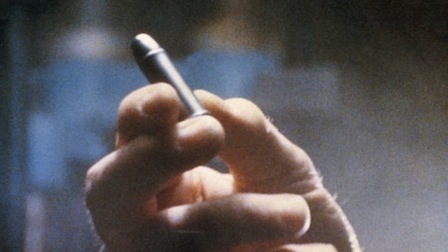
Here is where the siblings confess to their uncle about their letter-writing and that Lowe is the werewolf and that it tried to kill Marty at both bridges. So Red does a little investigating of his own and discovers paint from Reverend Lowe’s car on the wheelchair. He then goes to the Sheriff and persuades him to do his own investigation as Red is slowly starting to believe that Marty’s story could possibly be true. Skeptical, but desperate to find the killer, the Sheriff goes to the Reverend’s home to investigate and see just really what is going on. But before he can arrest him, the Reverend turns into the monster and kills him. With the sheriff now dead and out of the way, the siblings are now convinced that they are next. They give their uncle their silver necklaces and ask him to have a real silver bullet made as, according to the folklore Marty had been researching, this would be only way to dispatch of the creature once and for all. Red grants them their request and enlists the help of a local gunsmith to make them one shiny silver bullet, and they plan to take the Reverend out.


That night, it being Halloween with a full moon, the creature comes to their home with a mission to murder them all. Having fallen asleep in front of the television whose channel has just signed off, Red burns himself with the cigarette that was in hand and the threesome see the wolf outside hunting them in which now Red believes everything the children had ever said to them. Leaving them in complete darkness by cutting the electricity off outside, the monster smashes his way into the house and terrorizes them. The silver bullet falls out of the gun and into a furnace grill, leaving the siblings to try and retrieve it as Red fights off the werewolf. Just as it seems all hope is lost, Marty grabs hold of the bullet, places it in the gun and shoots the monster in the other eye, killing him instantly. The three of them hover over the body in horror as they watch the corpse morph back into Reverend Lowe. The siblings then profess their feelings for each other, realizing that what they’ve gone through together has made them stronger.


There is warmth to this film that isn’t felt in many conventional horror films. There’s a sense of community and a sense of family that makes me love this film in the manner that I do. I have to admit that I’m not a fan of Busey at all, but I really like his character in this film. There’s an esteem that he has for his niece and nephew and a devotion to them that makes the viewer believe that he really does love them. The way he surprises Marty with the new wheelchair and bag of fireworks, the way he pays attention to them – though up until the end he doesn’t believe anything they’re telling him – he sticks by them until the very end. The siblings look up their uncle, as well, knowing that though what they have to say is absolutely absurd, they can trust him. Haim plays the perfect Marty and he becomes the character so well that you can’t help but love the guy and his plight of wanting to be normal like the other kids, and his plight to win the love of his older sister. The film does a great job of setting up the small little town of Tarker’s Mills and you feel the sense of small-town sensibility among its inhabitants and a great job of setting up and presenting us the Coslaw family and their own relationships with one another. The murder scenes are set up and executed well and though not overtly gory, they are presented in a very terrifying manner. And though the film doesn’t exactly follow the original novella, it is worth multiple viewings.


I really need to find this DVD and get it into my collection. It’s been on my “Saved” Netflix list for the last year and half so I’m not sure if it’s out of print or just hard to locate. I have to admit thought that I’m not a fan of the whole werewolf genre. I’ve seen Wolfen, The Howling, An American Werewolf in London but I will say that this one is probably my favorite entry in this type of film. Maybe because there isn’t a whole lot of screen time given to the beast? Maybe because there’s more of a story that drives this film that just creature make up? Or is possibly because the characters in this film are so relatable and likeable that you root for them for the duration of the movie? Hands down, I love this film. If you don’t already have it/seen it, you need to. This is back when horror films were actually memorable, not like these modern-day PG-13 shit fests. Enough said. 

Sunday, October 7, 2012

The Killing Hour (The Clairvoyant) (1982)


I recently spoke to – well, actually ‘instant messaged’ – a fan of this here bloggo who was telling me how much he loved to read what I had to say. As flattered as I was by that much-welcomed compliment, what intrigued me was how the only complaint that he had was that I don’t update it enough. Though he admitted the prior was a selfish statement, he was absolutely right. And though I have admitted here on occasion that I don’t have the time to devote myself to this little piece of handiwork as much as I’d like to, one of the real reasons I don’t – or in this particular statement, can’t – update it as much as I’d like to is because with the monstrosity of a collection I have, there are many a night when I want to stay up and write but have the bloody hardest time choosing which film to review next. Should I go for a classic? Or should I try and maybe take a shot and review something a little modern? I can’t tell you how many times I will sit in front of my shelves and cases of endless slasher booty and just spend hours – literally – trying to decide which one to sit in front of next? There are many of those nights where I get so frustrated that I just give up and go to bed, telling myself, we’ll try this again tomorrow. Yeah, right.

Now that I’ve cleared that up, I’d like to take a quick moment and say ‘thank you’ to all of you that have taken time to read this little ditty. Within the last few months, my hit count has skyrocketed into the atmosphere and I know that it’s because of you all that it’s been possible. You guys send me the greatest emails and messages telling me how much you enjoy reading LL80’sH so for that, again, I extend my gratitude. It’s great to see that there are people out there not only reading what I have to say, but both relating to it and enjoying it. Mil Gracias! And I do have to pause and say thank you to Jay Rinella and John Gibben for hooking me up. You guys rock.

I did not know anything regarding The Killing Hour until about a year ago when I was doing some research online about the giallo genre and came across it in another horror blog. I had seen the cover to the DVD before at the San Jose Rasputin’s but never bothered to pick it up. I did a little bit of reading on this one and decided that I would seek it out, as everyone knows I love a good thriller. I also read that it was very minimal on gore which piqued my interest even more as some of the best fright films out there have little to no gore at all. They rely on set pieces, atmosphere, mood, and character development. Most of all, they rely on a good story and this one fits that bill like a glove.


The film opens up with an art class in session. An unseen student is sketching a nude model on her pad as police pull a handcuffed body of a dead woman out of a lake. Suddenly, student’s hand begins to sketch on its own and reveals a drawing of the same cuffed hands. The art student is beautiful Verna Nightbourne (Elizabeth Kemp) who has a special gift of seeing things and sketching them as they’re happening somewhere else. We then cut to the interior of a gymnasium’s swimming pool and watch rather voyeuristically as a man is frightened by having the lights in the building shut off as he is doing his laps. He calls out into the darkened room and is immediately taken underwater by an unseen assailant who handcuffs his ankle to the ladder under the surface, trapping him there. The slayings continue, with the third victim having been electrocuted while working in a manhole next to a local diner.  With the modus operandi being exactly the same in each murder, the police force, albeit with not much evidence to go on, begin to investigate.  The case is being led by officer Larry Weeks (Norman Parker) who has a penchant for stand-up comedy and impersonations of classic comedians.  For fear that the murder spree will turn into an uncontrollable media circus, the chief forbids any sort of communication with the media. But not before local talk show host Mac McCormack (the always unbelievably gorgeous Perry King), who just happens to be a personal friend of Weeks’, approaches him in the hope of getting the ‘inside scoop’ on the case. They make a deal: In exchange for information on the investigation, Mac will attempt to bring Week’s comedic talents to the TV network he’s employed by. Having obviously disobeyed a direct order from the Chief, he agrees to give Mac inside information on the now-dubbed “Handcuff Killer”.


Verna, convinced that she is able to see and draw the murders in this case as they are happening, is convicted to go to the police and aid them in their search for the killer. She presents them her sketches and they begin to analyze them in hopes of somehow using them to piece everything together. Weeks begins to date her, as does Mac and she soon becomes a part of both their lives. The only setback is that Mac wants her to appear on his television show to show the public what she can do and how closely it’s connected to all of the murders. This is not part of the deal that Weeks had intended and threatens to cut him off from any and all information regarding the investigation if she appears on his show. She agrees to appear just as a third victim is murdered, being handcuffed to the bottom of a freight elevator shaft and killed. The victim appears close to the beginning of the film in a hotel room with the likes of a Latino thug named Willie who actually becomes a very red herring at this point. Because it doesn’t make sense how – and why – he would be the one responsible for the murders. The police’s question now is, if a handcuffed woman was pulled out of the lake, why are all these victims of the same style of murder all men? We begin to wonder now if any – or all – of the victims had a connection to the woman from the lake. Who was she? And why is it that Verna can see – and draw – the murders as they are happen?


One day as Mac is returning to his apartment, he is attacked by Willie and beaten to the ground. When Mac’s housekeeper comes in and interrupts the altercation, Willie flees the scene and leaves a set of handcuffs behind. Mac immediately showcases them on his show and tells the police that he could very well have the identity of the Handcuff Killer. The police begin a manhunt for Willie and find him in his apartment and gun him down, thinking he’s the culprit. But, he isn’t. Well, at one point he very well could be because once Verna does appear on the show and draws the shape of a hand grabbing hold of a steering wheel, we see that someone assaults a friend of hers at the exact time she draws it and ties her up in her own car as she is going home from work and has her car tossed over a body of water. The film never really says who killed her but the only other person it could have been was Willie. Maybe because she was starting to ask so many questions about Verna’s drawings, was he afraid she would go to the police?  

I’m going to admit here that though the story as intriguing as it is, it’s very slow paced. If you’re expecting any kind of action or tension of any kind, you’re not going to find it right away. One of the reasons that I sought this film out is because it was recommended to me by a friend who claimed it was a ‘American-made giallo’ and that I would instantly fall in love with it. I hate to tell that friend that he was wrong…well, at least for the first half of the film. I will have to agree with him though that if this film had been made in Italy with Italian actors, it would be a giallo right on track with films such as Short Night of Glass Dolls and Who Saw Her Die? It concentrates on character development and story and if you’re not the type of person who can tolerate a slow-moving movie, you’re going to be very disappointed here. The murders aren’t gory. They are more implicit than explicit. But, one thing I will tell you is that if you love thrillers of any sort, don’t make the mistake I almost made and turn the film off! (I will confess that at about the hour mark, I was ready to turn it call it quits. Not so much because it’s very slow paced but because I’d decided to sit in front it during the late night hours and couldn’t keep my eyes open for much longer – and even Mr. King with his piercing eyes and fantastic body was somehow managing to lose my attention.) This is one of those films that you have to really sit in front of without any sort of distraction and one to definitely not watch in pieces. You have to pay attention to what’s going on in order for everything to make sense. Director Armand Mastroianni does a good job here of setting up the plot and silently begs you to just sit back and give the movie a chance. It’s not going to disappoint you. This is one of those films in which you have to be patient and wait for the goods to make themselves known.

So one night, Verna decides to have a glass of wine at Mac’s house and show her the latest picture that she’s drawn. It’s a drawing of all the victims so far and he begins to push her to draw her next one, but she can’t. With everything that’s been going on, she doesn’t have the mental energy to push through and draw and flees to the bedroom. It is here where the entire film begins its unexpected and amazing rush: Mac picks up the drawing while enjoying a glass of wine and begins to stare at the objects that she’s drawn. As he does, the police are looking at the other drawings that Verna has given them. They have been able to connect the sketches together to correspond with each of the victims. But there is one drawing that they can’t decipher. What is it? Is it a drawing of the inside teeth of one of the handcuffs? One of the detectives takes another look at it and suggests that it also looks like the inside of a crab’s claw. And when the scene immediately reverts back to Mac’s apartment to reveal Verna lying on his bed…next to a crystal sculpture of a crab’s claws on the nightstand…the film takes an amazing turn. We see Mac in the living room holding the sketch and we are immediately taken to a particularly disturbing flashback scene of a black-haired woman being handcuffed and tied to a bed in a random hotel room. She is obviously a hooker and she is surrounded by three burly men who are preparing lines of cocaine with the intention of gang-banging her silly. Her feet are being bound to the bed and as one of them unzips his fly and takes his pants off, inching to the bed and taking her head in his hands to bring her in close, I suddenly realize that the men are all the victims that were killed by the Handcuff Killer! And I seriously instantly emit a loud scream of shock when I see that the fourth man who slowly lies down on top of her and rapes her brutally as he kills her while the others watch is none other than Mac himself! What the f—k?!


Everything suddenly made sense. The woman found in the lake was the hooker whose body they’d disposed of in hopes that nobody would find out. Mac hired Willie to take out the other three either to throw the cops off or in case there was any chance of them going to the police. And once news had reached Mac that the other’s had been killed, he approached Weeks to get the inside scoop so he could know exactly what was going on, hoping that maybe Willie would take the fall for him. He’d asked Verna to come on the show out of his own disbelief that she would have known anything about the murders as they were happening and the more he got to know her, the more terrified he’d become that she was telling the truth! That’s was why he’d asked her to his home…to see exactly what she was going to draw next. He was afraid that she was about to figure the whole thing out! In pure shock, he squeezes and breaks the wine glass, spilling it all over the sketch.


At that moment, she realizes that she is next and flees to the bathroom as he comes after her. She hides in the shower after fooling him that she’d gone out the window and when he steps outside, she closes the window and makes a break for the outside hall of the apartment building. Mac sees her from the outside hall window and breaks it, sending her down up the stairs to the roof where he finds her and proceeds to kill her once and for all. Finally, dramatic and suspenseful tension! Just as we think she’s a goner, here comes Weeks to her rescue.  The two men wrestle it out and Mac ends up hanging over the edge of the tall apartment building, being held onto by Weeks. Knowing what he’s done and knowing that now there was no escape from death, Mac whispers softly. “Let me go” and Weeks reluctantly grants his wish as he watches him fall to the pavement. Nice!

The film ended up being much more entertaining than I had expected. You really had to follow the film and have patience with it and that’s one I need to stress about this film: Have patience! Not many casual movie watchers would be able to forgive the extent of its slow pace but it pays off in the final twenty minutes of the film. If you’re a giallo fan, such as myself, you will actually see many elements of the giallo genre in this film, right down to red herring(s), the use of black gloves, the obligatory twist reveal that it was one of the main characters the whole time, the altercation between the good guy and the bad guy, and lack of denouement. It’s too bad that this one is as underrated and overlooked as it is.

The DVD I have from Blue Underground is fantastic – as all the discs from BU are. The picture was clear, the sound was great and it had the original trailer. But, as I did research for this one, I read somewhere that the original VHS and subsequent DVD releases – even the original issue by Anchor Bay – had many scenes missing. This release has all the deleted scenes intact, most of them are extended pre-murder sequences that, in my opinion, explain more regarding the behavior and minds of the victims. Those missing minutes actually are quite essential as they would have given the story just a little more kick. I would love to see a special edition one day that has all the missing scenes put in with the rest of the film, just as it was done with My Bloody Valentine and Silent Night, Deadly Night. Maybe BU will give us a re-release. I’ve only seen this film on the store shelves once so I’m not sure if the BU version is already out of print – as I would only assume the AB version is already el-kaput. Before I went out and bought it, I was able to rent it off Netflix so if you’re the least bit interested, try to pick up there and take a look for yourself. It’s not going to be one of the best movies you will ever see, but it is definitely worth one viewing. Especially for the last twenty minutes where everything just comes together. (Pause) Well, okay…for the chance to see Perry King at the height of his 80’s heartthrob heyday. If you’re into that sort of thing (wink). 

Monday, September 24, 2012

The Changeling (1980)


If there is one thing I love, it’s a good scare. And I don’t mean one of those random jolts in a film that causes you to jump out of your seat and have your heart beat a million miles a second. I’m talking about a scare that lingers with you, that gets under your skin and stays with you as the lights go out when you go to bed. Those scares that stay with you for days, the ones that make you ponder and think. I can tell you that it does not happen to me very often. It could be that I’ve seen so many horror films that I’ve been desensitized to feeling anything once the end credits roll. It could be that deep inside of my mind, I’ve surrendered to the idea that I’ve finally dominated the skill of knowing how to watch these films and that absolutely nothing can scare me anymore. But the thrill I love most is when a film comes along and proves me wrong.

If you’ve read enough of these entries of mine, you’ll know that a lot of my youth during the 80’s was filled with endless trips to mom and pop/grocery store video stores and each one of them has special place in my heart. Every store had its own lineup of VHS resting against varnished oak shelves and if I close my eyes, I can still see the fourteen year-old version of myself walking next to them with an unknown excitement stirring within me. There was a naïve fascination inside of me with those colorful cardboard boxes and what was on them. I didn’t even know which one to pick up first, they were all so marvelous. But, for every thirty or forty that were staring back at me just waiting to be held in my arms, there were those few that I refused to touch solely because their artwork alone sent a spark of cold fear down my spine. 1980’s The Changeling was one of them. There was something about that image of the battered wheelchair covered in spider webs with the shadow of a boy’s ghost next to it that I couldn’t get myself to get past. This was one of those films I somehow knew would give me nightmares if I even dared to pick it up. And I’m being serious when I say that up until a few weeks ago, I never would have sat in front of it.

The haunted house genre of 70’s and 80’s horror films is one of my secret favorites. I don’t tell many people my love for those kinds of films for the junior-high playground fear of being laughed and poked fun at. I know that sounds strange from a man who is almost forty years-old but it’s true. There are those haunted house films that I will never be able to get enough of (i.e., The Haunting, Burnt Offerings, and The Legend of Hell House) but there are some of those that I wouldn’t go near because on that level, I felt like I was still a nine year-old boy. I know that sounds rather absurd but it’s the truth. So when I finally sat down and did my homework on this particular film, I immediately had to seek it out and finally treat myself to something that was long-time coming. And before I even begin the review, I have to say that I wasn’t disappointed.

The film opens up with a family pushing their broken station wagon in the snow. The father, Dr. John Russell (George C. Scott), a distinguished musician and composer, is on vacation in upstate New York with his wife and daughter when their vehicle breaks down. In hopes of getting it to a station to get it repaired, Dr. Russell separates himself and goes to find a telephone booth as his family stays with the car. As he’s calling Emergency Road Service, a large truck comes careening down the road from out of nowhere and suddenly loses control in the slippery, icy road and veers off the road and directly – and violently - into the station wagon and Dr. Russell’s family, all as he watches from afar. The film’s title appears slowly under the image of Dr. Russell helplessly struggling to get out of the phone booth. Just this opening prologue is terrifying in itself and it immediately sets the tone for the rest of the film.


Now having to put his life back together, Dr. Russell accepts a position as a music professor at a Seattle university and is looking for a house to rent as he feels he’s overstayed his welcome at a friend’s house where he’d been staying. With the help of a member of the local historical preservation society named Claire (the gorgeous and Scott’s then real-life wife Trish Van Devere – who would be later cast in her iconic role in the fan-favorite The Hearse), he rents a large Victorian home, known as the Chessman House – which hasn’t been rented out in twelve years - and slowly begins to live his life as he once did, but not before slowly – and without knowing – descending into something he would have never expected.  As the house is being fixed up for him to move in, Dr. Russell sits at the piano in the music room and as he sits, playing a piece he’s already composed, he walks away from the instrument and eerily, one of the keys is suddenly played by an unknown and unseen presence. Scary? Well, not right off the bat. But we’re only 14 minutes into the film. That evening, while out and about at a fundraiser for the local orchestra, we are introduced to Senator Joseph Carmichael who stands before the group and gives a speech. We find out from Claire that the Senator is on the board of directors at the historical preservation society – a most important bit of information whose reasoning will make itself known later in the film.

At 6 am the following morning, Dr. Russell is startled from his sleep at 6 a.m. from the sounds of banging echoing throughout the house. This is where it all begins, albeit, slowly. We then see him sitting at the piano and doing what appears to be composing a new piece of music when he is again startled by a noise in the hallway, thinking it’s one of the caretakers who then comes in from outside. He then goes back to the piano and begins to record a lovely classical piece of music. Let me say that the piece is eerie, yet beautiful – pleasing to the ear, but haunting. Claire then comes in to bring Dr. Russell some paintings that originally belonged to the house when she notices his study. Opening it, she finds the red ball that once belonged to his daughter (that was referenced at the beginning of the film). It sends him into a sad state, making him remember the tragic events of the day she and his wife were killed. Again the next morning – at exactly 6 a.m. and during a touching scene where he is crying in his bed from having been thinking of his family, he is again frightened by the same sound of banging echoing through the house. He calls a serviceman to come look at the problem and it is immediately dismissed as a characteristic of the house, though Dr. Russell sees the timing of the noises too coincidental. Later on that night, he finds the faucet in the kitchen mysteriously running on its own and when he shuts it off, the noises from upstairs continue and he goes to investigate. He opens one of the rooms and slowly walks inside only to discover the faucet running on its own in one of the tubs upstairs…and immediately sees the disturbing image of a boy under the water. Scary? It’s getting there.

The next day, he confronts Claire about something of this nature maybe happening to the people who lived there before and she immediately assures him that there is a possibility that he’s working too hard, and that with the emotional strain he’s been through that it could be a figment of his imagination. Dr. Russell is about to accept this hypothesis when they are interrupted by Clarie’s secretary, Minnie, who states her mother is on the phone. When Claire goes inside to take the call, Minnie takes it upon herself to tell Dr. Russell that the paperwork to rent the house out to him had been rushed by Claire. She goes on to tell him that nobody has been able to live in it and that the house doesn’t want any inhabitants, therefore further confirming his suspicions. But, does she know more than she’s willing to admit? The next day, Dr. Russell is leaving his home when a piece of red-tinted window explodes from the top of the house, landing in front of him. He looks up at the house and immediately, we can see that he’s beginning to believe something – or someone – is watching and possibly calling out to him. He makes his way to the top floor of the house and begins to look through the abandoned corridors.  At the end of one of the endless hallways, he comes across a door and walks inside to expose what appears to be a storage closet. He notices that a part of the room has been boarded up so he begins to take it apart only to find a locked door hidden behind panels of wood that had been nailed against it. When he grabs a hammer hoping to break the lock and begins banging on it rhythmically, the house answers with the same echoing booms he’s been hearing every morning. Now frightened, he finally breaks the lock and busts the door down and when it opens up for him, he walks inside. Scary? Yeah, it’s revving up nicely.


He walks up a long staircase lined with spider webs unveiling what appears to be an attic room. In one corner, the iconic wheelchair from the film’s one-sheet can be seen and lo and behold, the window with the red-colored glass is there behind it. He also finds a document in the room with the letters “C S B” inscribed on it dated January, 1909. But what provides the I-need-to-change-my-pants-now scare is that Dr. Russell comes across a music box…that plays the exact same tune that he’d composed earlier in the film! He brings his recording and the music box before Claire and plays both of them for her simultaneously to prove to her – and also possibly, himself – that he’s not crazy.  She immediately dismisses it as a “startling coincidence” and he then tells her about Minnie and the information she gave him that day he was at her office and its possible validity. He’s convinced now that someone – or something – deliberately attempted to get him up to the attic. And with that, he takes Claire up there with him so she can see it for herself. After a look through it and just as they leave the room, the chair slowly moves on its own. Scary? I’m actually slowly becoming afraid to write anything further.

So John and Claire go back to the historical preservation society only to discover that there is no information whatsoever on the house before 1920, which baffles her, as she is positive that some kind of documentation of past renters would be available. When she asks Minnie about the location of the files prior to that year, her response is, What is it you want to know? Either she’s in on it, or she’s a well-placed red herring! She claims a doctor named Barnard with a son and a daughter lived there that year but had to sell the house due to a family tragedy. They take this newfound information and go down to the local hall of records and find something interesting within its microfilm. They discover that on February 15, 1909 the Barnard’s seven year-old daughter, Cora, was stuck by a coal cart outside the Chessman House. This drives Claire to deduce that Cora is the “C S B” on the document found in the attic. They head out to the local cemetery and quickly find the hedge stones of the entire family and John can’t help but see a slight connection between the way Cora was killed and the manner in which his daughter passed. What is it in that house, Claire?, the doctor ponders. What is it doing? Why is it trying to reach me? Here is where the story begins to envelope you. And here is where the story is about to grab you and throw you into the lake head-first.

That night, John is sitting in the study spending a quiet night looking through photo albums of his family. In the background we suddenly hear what appears to be something coming down the stairs. Knowing that he is in the house alone, he gets up to investigate, only to see it’s his daughter’s red ball; the one that he kept in his desk that had somehow slowly bounced step by step down to the study on the ground floor of the house. Now, this has got to be, hands down, one of the most eerie, most well executed pieces of fright in the entire haunted house genre. John gets up, grabs the ball and goes immediately to his desk…only to find the ball missing. Who took it and how did they manage to get it? Oh dear, sweet Lord, if the hairs don’t stand up on the back of your neck during this scene, there is definitely something wrong with you. But it gets even more frightening: He then immediately gets into his car and drives to a local suspended bridge. He takes the ball in his hand, and tosses it over the edge. In the back of my mind I can’t help but wonder if he was going to know the outcome of this.  He comes home, places his coat on the bannister and thinks everything is fine. That is, until the room is suddenly filled with the sound of an unknown child’s laugher and as he stands motionless before the flight of stairs, the same ball that had frightened him just minutes ago, the same ball that he’s thrown over the bridge’s edge was now coming down step by step, stopping right in front of him as if it were announcing to him, I’m here. If you haven’t shit your pants at this point, seriously…I feel for you.


On the advice of a doctor, John brings home a psychic medium in hopes of finally getting to the bottom of the situation. I mean, when all else fails, have a séance! And not only have it, record it! The medium herself is scary as shit right off the bat, her eerie voice telling the group that something is there…a child who is not at peace. There is something unnerving about the tone of her voice that just gets under your skin. She begins asking questions into the open air writing madly away on white sheets of paper over and over again in hopes of getting something. She asks the spirit to communicate with them, to show himself, to speak to them. There is a sense of brooding fright that begins to come over you here at this point and just a word of warning: there is no turning back from here. When the medium asks if the spirit is the one of the dead girl Cora and the spirit immediately answers, “NO”, it reveals itself to have the name of “Joseph” and it begins to frighteningly clamor for help. Here is where the iconic tagline is spoken by the medium in her monotone, eerie voice: How did you die, Joseph? Did you die in this house? Why do you remain? The loud violent crash of a vase against a wall ends the séance, and leaves your heart racing. But, I warn you. It’s about to get worse.


Dr. Russell takes the recorded tapes of the séance and decides to listen to them later on his own. As he rewinds them over and over again in hopes of finding something that will lead him in the right direction, he is then stopped cold in his tracks by the sound of a child’s whisper in the background. Someone was there! When the medium asks the spirit for its name, John can clearly hear a child’s voice whispering “Joseph!” Son of a bitch, it gets so scary here! The voice on the tape begins to clearly tell John that he was killed by his father…in his room…the room upstairs. We are immediately taken (in fantastic POV) to the room upstairs to see a young boy bathing in his tub, his father standing over him dressed in black. The father takes his child by the feet and the boy goes underwater, struggling helplessly. We hear the echoing booming sounds from the beginning of the film and immediately discover that those sounds are/were actually the sounds of the boy banging his fists against the metal tub he’s drowning in! He bangs them repeatedly with all his might until the life slowly slips out of his little body. The scene is very disturbing and extremely frightening and ends with the boy whispering the words, “body”, “ranch”, “the well”, “sacred heart” and “My name---Joseph Carmichael”.  Does that name sound familiar? It should, because here is where the puzzle starts to come together.

John is now convinced that something within the house isn’t right. Reading the writing on the pages the medium left behind, he can see all the words he wrote that Joseph spoke as he listened to the tape. Distraught and very frightened, he goes to the telephone and calls for Claire, but before he can summon her, he passes out on the floor of the study from shock. Claire arrives shortly and distraught from all the information she receives from John about the séance, she confesses to John that “Sacred Heart” used to be the name of an orphanage in the town and John immediately begins to think the child was buried in a well there. But before they can do anything else, they are frightened by the sight of the small wheelchair watching them from the top of the stairs! The child’s spirit knows they are getting close to solving the mystery! Or does it?


The next day, John is walking about town and we see a limousine pull up to reveal the Senator (Joseph Carmichael) emerging from it. We see him walking to a building and having his secretary inform him that Minnie (Claire’s secretary) has been trying to reach him. Minnie advises him that John and Claire have been going through the files regarding the house and he takes down John’s name. But, what is she helping him hide? John and Claire then meet later on at a local café and we find out from Claire that the house was at one point going to be turned into a museum. John tells her that a Richard Carmichael and his family occupied the house from 1899 to 1906 and that Richard is the Senator’s father. We also find out here that little Joseph at age three was diagnosed with atrophic arthritis and that it had been decided to send the child to a sanatorium in Switzerland for specialized therapy. The child and his father went to Europe in October of 1906 and that they did not return to the States until WWI was over. So, with the child being ill, he was murdered by his father and buried secretly. A six-year old orphan substitute to take the dead child’s place was shipped immediately overseas to be with his father and it kept them both away until 1918! Upon his return, he would have been 18 years old so there was no doubt that anyone was going to find out that this changeling was not the real son of Richard Carmichael! And if anyone would ask about the illness the child had, it would simply be stated that the child had been cured while in Europe. Now the question on both Claire and John’s minds is, Does Senator Carmichael know anything about the murder and replacement and who he really is?

But, here’s the hatchet in the stump: Richard Carmichael’s wife was the daughter of the man who founded the Spencer-Carmichael Empire. So what does that mean? Mega money! Mr. Spencer had died in 1905 so the question of what happened to all that money in the will was now burning on John and Claire’s lips. There had to have been a ranch with either of their names on it somewhere. I mean, John had heard Joseph’s voice say it, right? And it had to be a ranch…with a well. Upon going back to the hall of records, It turns out there was indeed a Carmichael Ranch back then in Seattle complete with a well. But, a house now stood upon the original well itself and the record indicated the well on that site had been removed. When John goes there himself to investigate, he finds package outside the house addressed to a Mrs. E. Gray at 136 27th Street. Will coming back to talk to Mrs. Gray be key in solving this once and for all?

It turns out that in the will, just about everything was left to little five year-old Joseph Carmichael and nothing was left to his father, Richard, since he was just a trustee of the estate now. But he still could still control his son who was going to be worth millions and millions of dollars unless, for some reason the child was to die before age 21, in which the entire estate would be given to charity, leaving Richard with absolutely nothing. John and Claire go back to Mrs. Gray’s home in an attempt to find out if there really is a well under the house. After listening to his story, she tells him that on the exact night of the séance, her daughter woke up screaming just after nightmare and in a disheveled state, came to her mother’s bedroom and never returned to her own. The girl, Linda, claims to have seen a boy trying to come up out of the floor of her room. Knowing John’s desire to take the floors up and look for a well, Mrs. Gray tells them she has to think about it. Later on that night, Linda wakes up and begins to walk around the house. She goes back into the room where the apparition took place and is terrified to see the image of a boy under her floor…underwater. The bedroom is torn apart the next day and indeed, a well is found. Creepy? You’d better believe it! And what is it they find? A hand! A hand and the bones of a young boy that had been down in the well for 50 years. But the most important piece of the puzzle, an old medal belonging to the young Carmichael, was nowhere to be found.

Needing this crucial bit of evidence, John breaks into Mrs. Gray’s house and goes back into the well, determined to find that last piece of the puzzle.  With no luck, John steps away…only to suddenly see the medal come up eerily up from the depths of the ground on its own. There it was, in plain sight. He takes it and goes to show it to Claire who reads from it, “St. Paul’s Church – Sept 8 1900 – Joseph Patrick Carmichael”. At her request to show it to the police, John believes the authorities won’t want to fiddle with a seventy year-old case and that what needs to be done needs to be done his way, and on his own. He takes a drive out to the airport to find the Senator and finds him boarding a small jet on his way to Washington State.  John knows this is his only chance so he struggles with the Senator’s security people and tells him about the baptism medal with his name on it that was buried with the body and that the police are aware of it. The jet takes off and the Senator asks that a Captain De Witt be telephoned at police HQ and that he call him in Spokane once he lands. He then reaches into his shirt and we can see a similar baptismal in the Senator’s possession.

When John gets back to the house, he walks inside and suddenly and violently the house begins to react. Slamming doors, boom upon boom echoing through the corridors. Here is where he becomes exasperated and begins to confront the spirit in the house, telling it that there is nothing more he can do. Captain De Witt then comes to visit John at the house, most certainly at the request of the Senator, asking question upon question in an attempt to find out what happened back at Mrs. Gray’s house and to accuse him of a possible blackmail scheme concocted by John himself. The captain even tells John that the Senator wants the medal back. It is here that Claire comes storming in to tell John that not only has his lease been cancelled, but that she’s been forced to resign. So where is this all leading to?

As John grabs hold of the medal and walks by the downstairs mirror, it violently explodes sending a shard of glass into his neck, but not before we see the bloodied face of Captain De Witt. Claire calls the house, frantic, telling John that the Captain’s car flipped over and that he’s dead. Carmichael himself receives a call in his limo to inform him of the death of the captain and he proceeds to go ahead and finally call John to meet with him. They finally meet privately in the Senator’s office but while this is happening, Claire is trying to contact John with no luck. She leaves her mother and goes to look for him. While in the Senator’s office, John begins to confront him about the things happening within the house and presents him with the medal, explaining to him where he found it and explaining to him the history of what’s been going on within the house. He then proceeds to tell the Senator that his father, Richard, killed the young Joseph and that there was a substitution from the Sacred Heart orphanage to replace Joseph, and that the changeling was him. Furious, the Senator pulls out his checkbook thinking it’s still an act of blackmail. John tells him again that his father was a murderer and that nothing in his life and that nothing that he has is real because he is not Carmichael’s blood son. John leaves him the paperwork found at the city and the only tape of the séance to prove everything to him. The Senator succumbs and gives in, telling John that he cannot breathe a word of this revelation to anyone – and John walks out, leaving the Senator alone.

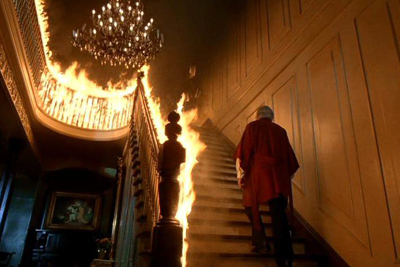
Claire goes back to the house to look for him and as she proceeds to knock, the house lets her in on its own. She finds the house empty and suddenly, it begins to call out to her as if it were John. Something is in the house with her and it begins to fool her thinking John is there. She begins to walk upstairs through the corridors and thinking that he is calling her, she makes her way upstairs to the room only to have the wheelchair come to life and come after her. It chases her and throws her down the stairs and follows her as she lies on the floor screaming out in terror. This scene is so terrifying it will jolt you right out of your seat. You’ve been warned. John comes back to the house to find her screaming and horrified. Here is where the house begins to get its final revenge. John goes into the house and begins to confront the spirit of the young Joseph while making his way upstairs. Doors blow open, wind tears through the house and the force of the wind knocks John from the second level to the floor downstairs.  A trail of fire makes its way from the top of the stairway down the bannister as he lies on the floor, helpless.


Back at the Senator’s office, he is staring at the medal and hearing the voice of Joseph. He places it on his father’s portrait and it begins to shake violently. We then see an image of the Senator inside the now burning house as John looks up to see him walking up the stairs. The burning stairs implode, leaving no way to get to the upper part of the house. The chandelier swings violently back and forth and disconnects itself from the wall, crashing to the ground, missing John by mere inches. He is able to escape the house while the Senator is still upstairs and as he reaches the room, he is confronted by the image of his father killing young Joseph in the tub. He knew what had happened the entire time. He knew exactly what had taken place that night. As the ghost of young Joseph inflicts itself on the Senator, the boy’s bedroom atop of the house explodes. The house burns to the ground as the Senator is taken away by an ambulance as Claire and John watch from a distance.


The next morning, we see a glimpse of the ruins that were once the Chessman house. As the camera pans over the damage and charred remains that are left behind as testimony of the supernatural confrontation the night before, we see the music box that John found at the beginning of the film in the boy’s room lying out within the rubble. It suddenly opens up on its own and the sound of its song plays into the open air as the film comes to a close.

This has got to be one of the most frightening films I’ve ever seen. The story was well-written, it was well-executed and I can honestly say that it’s unforgettable. It’s very rare that I sit in front of a film that gives me the genuine heebie-jeebies and for the sake of this review, it is the second time I’ve sat through it and even the second time if managed to terrify me. These days, horror relies too much on CGI and those graphic in-your-face explicit moments where nothing is left to the imagination. All of those endless “found footage” crap-fests and modern “haunted house” films that Hollywood churns out every year will never compare to a well-written masterpiece such as this. There is uneasy feeling that’s left in the pit of your stomach when the credits roll here and I can’t even remember the last time a film did that to me. You always know that a fright film did its job when you go to sleep and still think about it the next day. This film is a great example of how a story, its characters and their struggle can lodge themselves in your mind and leave a lasting impression. I can probably say that this is now my favorite haunted house film and I’ll probably get a lot of beef for saying that but that’s why I love being a horror auteur. Every horror fan has those films on their list that rock their world and forever change the way they watch films altogether.  The DVD by HBO Home Video is absolutely gorgeous with a very crisp and clear picture and print. The score is absolutely gorgeous – I actually wished I would have watched it with my home stereo – and everything about the DVD release is fantastic – albeit, it’s missing the film’s trailer. I read somewhere that this HBO disc is out-of-print and I have to say that it may possibly be true as I have yet to find it on a store shelf anywhere. I absolutely recommend this to anyone who loves their scares on a minimalist level or those who hate the wave of “modern horror” that’s been blasting theater screens. If you love a good haunted house story, sit in front of this. You will be so glad that you did.

P.S. I love the Spanish title of this film, Al Final de la Escalera. (At the end of the Staircase) 


Sunday, August 12, 2012

The House on the Edge of the Park (1980)

One of the things I love the most about films from the other side of the world, particularly Italy, is that most of them come with reputations that have followed them throughout the years. If you’re a die-hard horror fan, you’re totally aware of a little list coming from the United Kingdom called the “British Board of Classification Department of Public Prosecution’s List of Video Nasties” (or “The DPP list” for short), a list of 74 films that were banned overseas for their graphic content and subject matter. If you’re a horror fan, you know exactly what I’m talking about. Some of them are upheld with gusto and others fall flat on their face, depending on your own individual tastes. If you know the list well, you’ll wonder why some of them were even banned since they’re pretty tame, making it obvious that the persons prosecuting said films never took the time to watch them in the first place. 

This particular list has been somewhat of a challenge for horror fans that spend their time – and sometimes, their hard earned money –  to collect every single film on the original list. Some of them are hard to find since they haven’t received proper DVD treatments and collectors sometimes have no choice but to hunt down hard-to-find out-of-print VHS releases. I, myself, have 37 of the 74 films on the list, but only because some of them on the list are either of no interest to me or are so hard to come by that they aren’t worth hunting down.

Growing up in rural Texas in the 80’s, I don’t recall ever seeing this title sitting on the shelf of any grocery store or mom and pop video house. I didn’t even hear about this film until the early turn of the decade just as I’d been starting my collection of Euro-shock films – I didn’t get into collecting them hardcore until about 2004 but I had to start somewhere, did I? I read an article online about it and was immediately fascinated by the film’s concept and knew that I needed to hunt it down. I looked at a few sites over the internet but couldn’t find it – since, at the time it hadn’t been released properly on the DVD in the States – and I found one NTSC VHS version on eBay but it was going for ridiculous money so I passed. About a year and a half later, I was living in Missouri and whilst shopping at a best buy in Independence I picked up a DVD compilation with the title, “Great Horror Classics vol. 8” released by a little company known as Echo Bridge Entertainment. It was being sold at a very low price and the reason I’d picked it up was because it had Don’t Look In The Basement!. As I was at the cash register, I took a look at the list of films on the DVD and I practically shit my pants to read that House on the Edge of the Park was included. So that night, whilst on the graveyard shift at the local Courtyard by Marriott, I finished my work as soon as I could, popped this into my laptop and sat back. And did I mention that the DVD case labeled the film as being uncut and unrated?

The first thing I was treated to after the prologue was a fantastic montage of New York City, Twin Towers and all, with one of – if not the – smoothest and most memorable disco tracks ever to be dubbed onto a horror film. As I said in my reviews of Cannibal Ferox and New York Ripper there is something just fantastic about Italian exploitation films and their soundtracks that just run a shiver of awesomeness down my spine. This one which I lovingly refer to as “Do It To Me Once More” – since I don’t know it’s original title – is so great that once you hear it for the first time, you’ll want to listen to it again and again. But before this review goes into controversial length, let’s get to the film itself.

Die-hard exploitation fans already know this one well. The film opens up with the great David Hess playing a thug named Alex who follows a girl home from a disco and rapes her in the back of her car and leaves her dead. From the start you’ll wonder if you’re actually watching The Last House on the Left – part 2 as the character of Alex is pretty much a doppelganger of Hess’ character Krug from the original LHOTL (Just as his character in Hitch-Hike is, in actuality, both of those characters). Once he leaves the girl for dead, he and his cohort Ricky (Giovanni Lombardo Radice (John Morghen) in his first role) are out to find a place “to boogie” and while in an auto repair shop come across and meet Tom (Christian Borromeo of Tenebre and The Pleasure Shop on 7th Avenue) and Lisa (Annie Bell), a young couple who are having car trouble and come hoping that their shop is open and offer them money to give it a fix. When Alex and Ricky can’t get to the disco because of the inconvenience, they’re immediately invited back to the couple’s posh home to join a party that’s already underway. When they get there they meet Gloria (Lorraine Di Salle – Cannibal Ferox), her boyfriend Howard (Gabriele Di Guilio), and Glenda (Marie Claude Joseph).  After an icebreaker of some disco-dancing consisting of a horrible semi-strip tease for the ladies by Ricky and a poker game gone horribly awry, Alex pulls out a straight razor on the group and the fun begins.  Now, before I go on, I have to touch on the subject of Ricky’s dance. Seriously, this is one of the funniest and most preposterous full-body dry-heaves in horror history. It’s that hilarious that you’ll want to rewind it and watch it a few times. Though the top honor still belongs to Crispin Glover’s character in Friday the 13th – The Final Chapter, but this one comes in very close second. If his intention was to induce any sort of arousal, it’s an epic fail of mammoth proportions, even on this end of the viewing spectrum. And that’s pretty bad, because Ricky is pretty darn cute.

But, as Alex watches from the sidelines, he looks like he doesn’t like one bit of Ricky getting all the attention. Hello, is that jealousy calling? So what does he do? He takes Lisa over to the kitchen to work his magic on her. When she rejects him, Alex grows tired of the situation not going in the way he wants it to so he turns the tables and makes the group pay. Acting as Ricky’s coach – since it’s apparent that he’s a few floats short of a parade and pretty naïve in the sex department – he coaxes his partner to cohort in sexually violent atrocities and acts of humiliation that terrorize the group.  


The rest of the film becomes scene after scene of humiliation and sexual titillation.  It does push envelopes but only manages to push them to just the end of the table. Why this was so outlawed and banned is still a question I’d love answered. Though the BBC had issues with glorified sexual violence, this one, in some respects, was more bark than bite. There were boobs-a-plenty and even male nudity to an extent, but it really doesn’t deliver in the exact manner that you think it’s going to. When you really sit down and analyze the film, it’s never explained why Alex goes on his rampage. It would have been great to see what his motivation would have been. And though you have to take it at face value – in other words, Alex did it because he could – there has to me something more in his backstory that would explain what would drive him to do the things he did to the group.

And it all reaches the boiling point once the character of Cindy is introduced. By no fault of her own, she is thrown into the vortex of Alex’s disturbed mind and sadly, she gets the brunt of it. This scene on its own is probably the most difficult to watch, as Alex disrobes her, humiliates her, and slices her naked body with the straight razor over and over again as the others watch in horror. For being the 70’s I could only imagine audience’s reactions to this. But, here is where the film takes its pivotal turn. Ricky sees what is happening and attempts to be the voice of reason to Alex’s disturbed mind. He tells Alex that one day he is going to go too far, that he is going to someday be unable to stop and tries to convince his friend that there is still time to turn around. But Ricky himself goes too far, by reminding Alex about “the girl from last year” – obviously referring to the start of the film and the altercation between Alex and the girl he followed from the discotech. This becomes the final straw for Alex and it is at this moment when everything goes awry. In a fit of rage, every ounce of Alex’s anger culminates into one strong swing of the razorblade and without even thinking (possibly) he slashes Ricky right across the chest, knocking him to the floor.   Ricky, in total shock and disbelief, lies there with blood on his hands and on his body and Alex slowly begins to break, and here is where everything unravels. Alex, instead of taking responsibility for his own actions, tries to pawn them off on Ricky as being the cause of what just happened. Why did you make me do this, Ricky?  And speaking of this scene, it’s here where Alex begins to show an emotional side not previously seen – In the scene where Ricky attempts to rape Gloria and Ricky barks back at Alex, Ricky apologizes for having yelled at him, and Alex accepts his apology and kisses him on the cheek, not once, not twice, but three times. He goes on by telling Ricky – as Ricky is lying on the floor covered in blood – that It’s always been just you and me, kid and You can’t leave me now, Ricky. It makes you wonder just what kind of a relationship they really had. Especially since it was hinted at in the beginning of the film, when Alex becomes jealous when Ricky dances for the group and gets all the attention.


But here is where the film finally reveals its twist. As Ricky lies there in his own blood, Tom secretly goes over to a drawer and pulls out a gun and pulls it on Alex, telling him that the entire night had been a setup and that the girl that Alex raped in the beginning of film was, in fact, Tom’s sister. Do you smell pre-meditated revenge? I think so! If you paid attention at the beginning, Alex takes a pendant that the girl was wearing and places it on himself. So it’s here that Tom takes up all of his nerve and shoots Alex in the leg, then the shoulder. But the best part of all, the coup de grace, is when he takes the final shot and shoots Alex in the groin! What transpires here is one of the most frightening, most disturbing screams in the history of horror cinema and you have to experience it for yourself to believe it. It will stay inside your head for hours after you’ve heard it and it’s one of the effective scenes in the entire film.  Alex, gasping his final breaths, manages to climb out of the pool and it is here where Tom rips his sister's pendant from the killer and reclaims it, tossing him back into the water. Once Alex is face down in the pool, Tom hands the gun to Lisa, who takes a shot at him. She, in turn, hands the gun to  Howard, who takes his chance in taking his own revenge for Alex having tied him up for most of the film. Once Alex is finally dead, Howard, offers the gun to Gloria, who refuses.

Once the denouement begins, we still see Ricky bleeding inside and Howard goes to finish him off, Ricky pleads for him to shoot him, to which Gloria convinces him not to do it. The film ends here but you are left to wonder about the deeper aspects of the film: Did everyone that attended the party know what was going to happen and know that Tom and Lisa had the entire night planned? Were the other members that were present family members/friends that had hoped to get revenge on the death of Tom’s sister at one point or another? If so, were they really willing to risk their own safety and lives for the sake of retribution? As interesting as those musing are, for me, the biggest question of all is: How did {Tom and Lisa] know who Alex was in the first place? Did they see the murder occur? Were they all at the same disco that night and just happened to remember his face? How was it that they knew exactly where to find them and how is it that they were so confident that the duo would actually accept their invitation? I know that your suspension of disbelief has to be in its highest mode if you’re going to pose these questions, but all in all the film works, even if it does on the smallest level. For the reputation the film has carried throughout the decades, it isn’t as bad as it’s made out to be. But don’t let that stop you from watching it at least once. It’s a great piece of cinema made in a style that isn’t made this way anymore. The Shriek Show disc was beautifully re-mastered – in Anamorphic Widescreen - in both picture and sound and it looks fantastic. The major difference between the version on the EB disc and this disc is that the EB disc has the original Italian title cards in place and the latter replaces them with ones in English. There is an interview with Hess himself that’s a little on the bizarre side – watch it and you’ll see what I mean – that is worth watching. And for those of you who are wondering, both prints are uncut.

This is one that is essential viewing if you’re a fan at all of Italian exploitation cinema. I’m not sure how available the SS disc is, as I haven’t seen it on store shelves for a least a year. I do know it’s on Netflix so if you get  a moment, seek this one out. It’s worth looking at and will remind you of the days when exploitation cinema was at its absolute best. Oh, and if you don’t know already, there will be a House on the Edge of the Park – Part 2 coming out either later this year or next year. 


Yes, you read that correctly. David Hess was originally attached to the project but sadly passed away a few years ago. From what I’ve read, HOTEOTP part 2 will take place thirty years after the original, with Ricky – Yes, Radice will be reprising his role -  having served his time in prison for the events that happened in the original and the film taking place just as he is being released. Ricky will once again get mixed up with the wrong people and repeat the cycle all over again. Surprisingly, Rugerro Deodato will sit in the director's chair for this sequel, which honestly, I'm excited about. If you’ve seen the original and love it as much as I do, you just have to be curious on how this is going to be pulled off. We’re not holding out breaths, though, since films like these always end up being duds. But for this one, I think I’ll keep my fingers crossed.